Mobile Phone Repair Course Overview
Comprehensive training in advanced mobile phone repair techniques
Mobile Phone Repair Course Curriculum
Comprehensive modules covering all aspects of mobile phone repair
Why Choose Our Advance Mobile Phone Repair Course?
We provide the best training experience with industry-leading facilities
FAQ
This course teaches complete mobile repairing skills, including hardware and software troubleshooting. Students learn theory, practical repair techniques, IC reworking, motherboard analysis, and advanced smartphone diagnostics.
Anyone interested in mobile repairing can join — students, job seekers, shop owners, and working professionals. No technical background is required.
The course duration usually ranges from 1 month to 3 months, depending on the selected level (Basic / Advanced / Chip-Level).
Yes, after successful completion, you will receive a Government/Institute-Recognized Certificate that can help you start your repair career or business.
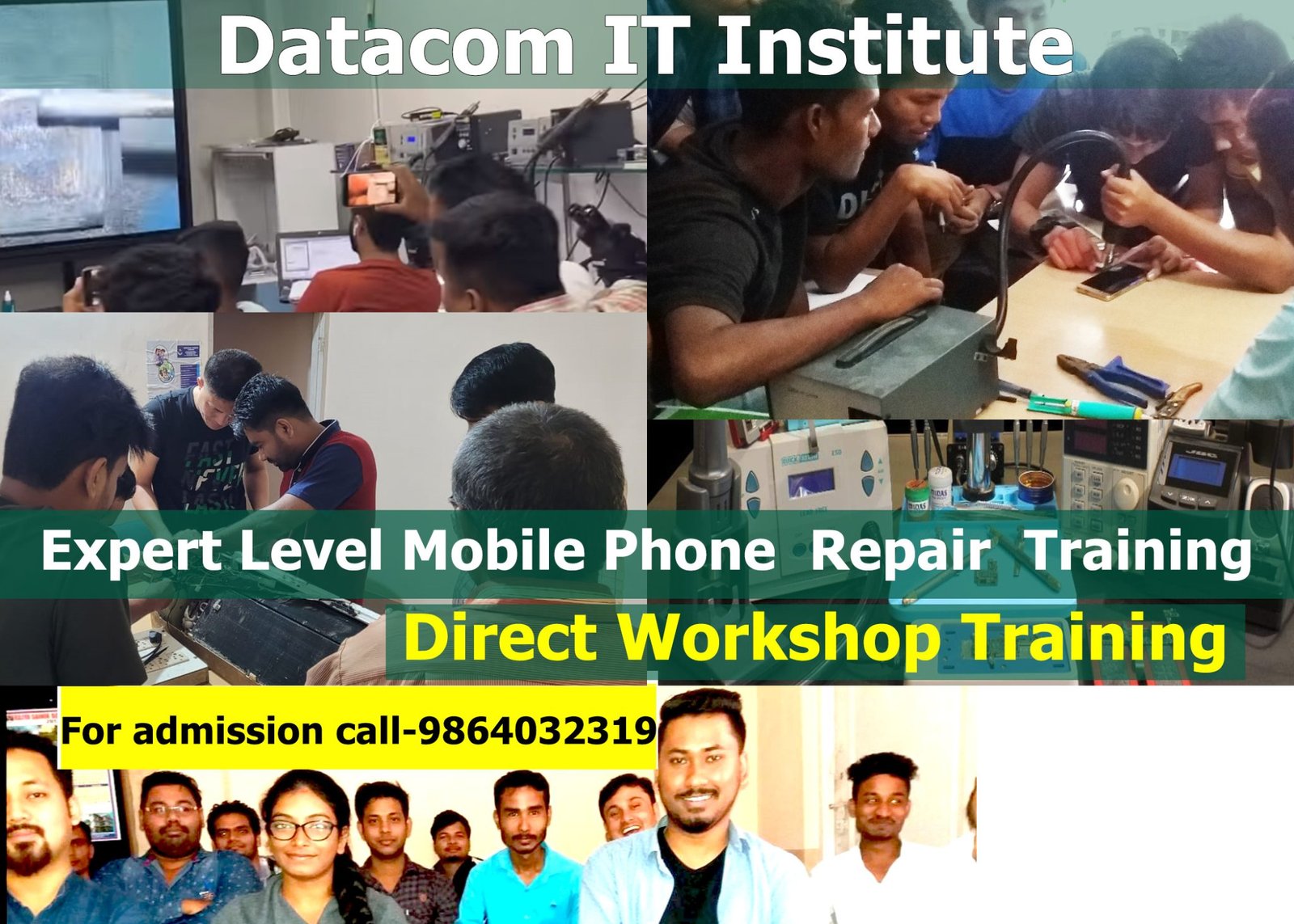
Yes. Hands-on practice is a core part of the training. Students repair real mobile phones, use professional tools, and learn live troubleshooting.
Course fees vary depending on the selected level. Please contact us or visit the institute for the latest fee structure and offers.
Yes. We help students with:
-
Placement support in service centers
-
Business setup guidance
-
Wholesale tools and spare parts suppliers list
Advanced Mobile Phone Repair Technician Syllabus
Course Overview: This advanced mobile phone repair course in guwahati at Datacom Institue is designed for experienced repair technicians seeking to elevate their skills to a professional, component-level standard. The curriculum delves deep into electronic theory, schematic reading, micro-soldering techniques, complex diagnostics, and the repair of intricate subsystems like baseband, RF, and power management. Graduates will be equipped to handle data recovery, liquid damage restoration, and business-critical repairs that are beyond the scope of most repair shops.
Learning Objectives: Understand the core electronic principles that govern modern smartphones and learn to use service documentation as a roadmap for repair.
-
Topic 1.1: Deep Dive into Smartphone Architecture
-
System-on-a-Chip (SoC) breakdown: CPU, GPU, NPU, ISP.
-
Memory hierarchy: NAND Flash, DRAM, and their interfaces.
-
Understanding the Printed Circuit Board (PCB): Multi-layer boards, blind and buried vias.
-
-
Topic 1.2: Advanced Component Recognition & Function
-
Integrated Circuits (ICs): BGA, QFN, CSP packages.
-
Passive Components: Resistors, Capacitors (MLCC, Tantalum), Inductors, and Diodes.
-
Active Components: MOSFETs (P-Channel & N-Channel), Regulators (LDOs), and Crystal Oscillators.
-
-
Topic 1.3: Schematic & Boardview Navigation
-
How to source and use official schematics, boardview (.brd, .f2b), and PCB layout files.
-
Interpreting symbols, net names, and power rails.
-
Tracing signals from a fault back to the source using documentation.
-
-
Practical Lab:
-
Identify 20 critical components on a donor board using a schematic.
-
Trace the power path from the charging port to the battery.
-
Learning Objectives: Develop the high-precision hand skills required for soldering and de-soldering miniature components.
-
Topic 2.1: Advanced Tools of the Trade
-
Microscope Use: Optimal lighting, magnification, and ergonomics.
-
Temperature-Controlled Soldering Irons: Fine tip selection and temperature profiles.
-
Hot Air Rework Stations: Nozzle selection, airflow, and temperature calibration for different ICs.
-
Jigs and Fixtures: Securing the board without causing damage.
-
-
Topic 2.2: Component-Level Soldering Techniques
-
Tack Soldering for tiny capacitors and resistors.
-
Drag Soldering for fine-pitch connectors.
-
Using Solder Paste and Stencils for multi-component replacement.
-
-
Topic 2.3: BGA Chip Removal and Installation
-
Theory of BGA soldering: Ball grid array, reflow process.
-
Proper IC underfill removal and application.
-
Step-by-step process: Flux application, even heating, “lift” test.
-
Reballing: Using jigs and manual techniques to replace solder balls.
-
-
Topic 2.4: Board Preparation & Pad Repair
-
Cleaning and re-tinning pads.
-
Identifying and fixing lifted pads.
-
Running jumpers (using magnet wire) for broken traces.
-
-
Practical Lab:
-
Remove and reinstall a small BGA IC (e.g., a Power Management IC – PMIC).
-
Perform a pad repair on a lifted connection.
-
Reball a donor chip using a stencil.
-
Learning Objectives: Diagnose and repair complex power-related failures, from no-power conditions to fast charging issues.
-
Topic 3.1: Power Distribution Network (PDN)
-
Mapping the main power rails (e.g., VDD_MAIN, PP_BATT_VCC).
-
Understanding the role of the Primary PMIC and Secondary PMICs.
-
Sequencing: The critical order in which power rails turn on.
-
-
Topic 3.2: Advanced Charging Circuit Diagnostics
-
USB-C Controller (UFP/DFP) and Charging IC communication.
-
Fast Charging Protocols: Qualcomm Quick Charge, USB Power Delivery (PD), proprietary protocols.
-
Troubleshooting Tristate Charging Ports.
-
-
Topic 3.3: Battery Circuit & Fuel Gauge
-
How the Battery Management Unit (BMU) and Fuel Gauge IC work.
-
Calibration and data line communication (SMBus, I2C).
-
Repairing “Battery Health Not Available” or inaccurate percentage issues.
-
-
Practical Lab:
-
Use a DC Power Supply to inject voltage and find a short on a power rail.
-
Diagnose and repair a phone that does not fast charge.
-
Learning Objectives: Diagnose and repair faults in the cellular and wireless communication systems.
-
Topic 4.1: Cellular Signal Path
-
Antenna Switch Modules (ASM), Power Amplifiers (PA), Low-Noise Amplifiers (LNA), and Transceivers.
-
Baseband Processor and its relationship with the RF system.
-
Common faults: “No Service,” “Searching…,” weak signal.
-
-
Topic 4.2: Wi-Fi & Bluetooth Co-Existence
-
Combined Wi-Fi/Bluetooth ICs and their interfaces (PCIe, SDIO).
-
Diagnosing grayed-out toggles, failure to enable, or weak connectivity.
-
-
Topic 4.3: Introduction to Baseband EEPROM
-
The concept of IMEI and baseband firmware.
-
Causes of “Invalid IMEI” or “No Baseband” and potential repair strategies (including chip replacement/reprogramming).
-
-
Practical Lab:
-
Use a known-good antenna to bypass a suspected faulty ASM.
-
Measure RF power rail voltages to diagnose a “No Service” issue.
-
Learning Objectives: Address complex, multi-faceted failures and understand the repair landscape for new device types.
-
Topic 6.1: Advanced Liquid Damage Restoration
-
Corrosion mapping and advanced cleaning techniques (ultrasonic, specialized chemicals).
-
Identifying and repairing corrosion-damaged passive components and board traces.
-
-
Topic 6.2: Biometric System Repair
-
Fingerprint Sensors (Capacitive, Ultrasonic): Calibration and replacement protocols.
-
Face ID (TrueDepth Camera): Dot Projector, Flood Illuminator, and IR Camera repair. Understanding serialization and component matching.
-
-
Topic 6.3: Camera System Deep Dive
-
Multi-camera arrays and their controllers.
-
Diagnosing focus (OIS/VCM), image stabilization, and image processing faults.
-
-
Topic 6.4: Foldable & Dual-Screen Devices
-
Unique challenges: Flexible displays, hinge mechanisms, and complex ribbon cable routing.
-
Diagnosis and safe disassembly procedures.
-
Learning Objectives: Develop a systematic approach to diagnostics and understand the business of running an advanced repair service.
-
Topic 7.1: The Scientific Method of Diagnostics
-
Developing a logical, step-by-step diagnostic flowchart.
-
Using Amperage Draw on a DC Power Supply to diagnose boot stages.
-
Using Thermal Imaging to locate short circuits.
-
-
Topic 7.2: Quality Control & Customer Communication
-
Pre-and-post repair checklists.
-
How to quote for advanced repairs and manage customer expectations on data recovery.
-
Warranty policies for board-level work.
-
-
Topic 7.3: Sourcing & Inventory Management
-
Identifying reliable sources for ICs and donor boards.
-
Managing an inventory of salvaged components.
-
Our Advantages
What makes us the best choice for mobile repair training in Guwahati
Career Opportunities
Multiple career paths after completing our advanced mobile repair course at Datacom Institute , Guwahati
Meet Your Instructor
Learn from an industry expert with extensive experience

Meet Your Instructor
Senior Mobile Repair Specialist
With over 10 years of experience in mobile phone repair and chip-level servicing, Rajesh has trained hundreds of students who are now successful technicians across Northeast India.
He specializes in advanced motherboard repair, data recovery, and has worked with all major smartphone brands including Apple, Samsung, Xiaomi, and OnePlus.
Our Advanced Lab
State-of-the-art facility equipped with modern tools and equipment
Photo Gallery